

ONLINE EXCLUSIVE: Escape the Improvement Trap
 By Lea A.P. Tonkin, editor-in-chief
Many leaders seeking ways to boost their organization’s performance mistakenly believe the company’s performance is world-class. After all, they may have worked for years to implement lean, six sigma, and other continuous improvement (CI) tools.
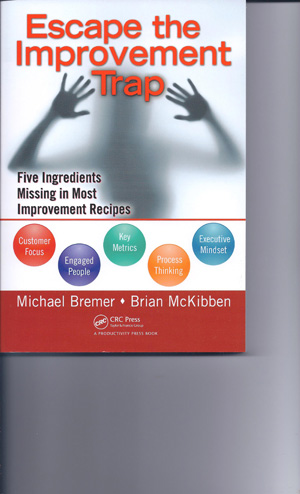
“The reality is that they are probably average,” said Michael Bremer, principal of The Cumberland Group, Hinsdale, IL. Bremer and his business partner Brian McKibben wrote Escape the Improvement Trap: Five Ingredients Missing in Most Improvement Recipes.
“You may be getting better, but you are doing pretty much the same thing as your competitors, so your competitive position has probably not changed. Your improvement maturity is only average,” he said.
Elite performers distinguish themselves from average competitors in terms of improvement maturity. Bremer said candid responses to the following three questions will yield valuable information about your organization’s long-term improvement capabilities:
- Have you been able to dependably sustain and replicate elsewhere the gains from improvement projects?
- Have key overall business performance metrics such as financials, new revenues, customer loyalty, and strategic results shown meaningful change as a result of improvement initiatives?
- Are your employee engagement survey scores more than two times your industry average?
If the answers to these questions reflect the need for progress, Bremer suggested focusing on five key areas:
1. Make sure customer value drives improvement. “Very often, a company’s strategies, such as launching a new product, are mediocre because they are not focused on doing what is needed to build competitive strength. If you talk to 10 people on the leadership team, you get 10 slightly different variations of which customers are important and why they buy from you,” Bremer said. “Consider the 80/20 rule: If you have more than 200 customers, 20 percent of your customers account for 80 percent of your profits – what I call the Mojo customer group. Fifty percent of the customers (the ‘Ugly 50’) are only a small percent of your profit. At the same time, the ugly 50 may actually be draining resources such as product innovation out of your organization.
“Focus on the Mojo group, your best customers. They are 16 times more profitable than the Ugly 50. What are you doing for your Mojo group that truly meets their needs? Most companies don’t go beyond the customer profitability report when looking for information that will help them develop effective strategies.”
An effective means of gaining critical feedback on creating customer value is for each member of the leadership team to “own” at least one significant customer that they talk to at least once a month and visit periodically, gathering suggestions for serving them better. “It’s called going to the gemba – breaking out of the insulated mode,” Bremer said. “What you are doing is aligning the value proposition for your organization. It’s a shared understanding of value, a crisp definition that enables the organization to develop related strategies and metrics.” He contrasts this approach to the more common focus on short-term, problem-solving activities (improving delivery performance issues, for example). These activity-driven traditional metrics are accumulated when it’s too late to influence results.
2. Engage people’s passion and creativity. When leaders spend time with employees actually doing the work (manufacturing products, working in a call center, etc.), they can tap into internal and external customer issues. Leaders need to support their employees and nurture their problem identification/solution skills, Bremer said.
“If an employee has an improvement idea, are they comfortable talking to their boss about it? Many people feel that their bosses are not receptive to new ideas,” Bremer said “If the idea is a good one, the organization misses out on a learning ‘nugget’ that can make a difference in improving their competitiveness. If the idea is not so good, the organization misses out on an opportunity to help that employee develop better critical thinking skills. So the organization loses both ways.”
3. Establish key metrics. Many organizations are drowning in metrics, Bremer said. Rather than use obvious metrics, he suggested that leaders focus on metrics that will lead to results that will benefit customers’ competitive capabilities. “You need clarity about metrics,” he stated. “If the organization’s value proposition is not crisp and accurate, how effective can your metrics be? Many organizations think they are measuring the right stuff. But are Company A’s metrics different from those at Company B? It would be more powerful to get metrics that help me to create more wins in my business. If you measure the same things everyone else measures, how different are you going to be? You also tend to find people arguing from their functional responsibility perspective on what qualifies as a “win.”
Some companies lack a clear understanding of the total cost of ownership, Bremer said. For example, if they source offshore, they may not look beyond labor and transportation costs. Lost opportunities for meeting spikes in consumer product demand and other costs (travel, quality, intellectual property, flexibility) should be considered, he counseled. Develop process thinking/understanding capabilities. Internal metrics for a department should make the departments they serve do a better job of serving their customers. (These “customers” may be another internal function.)
4. Develop process thinking/understanding capabilities. “Holistic thinking is needed. Many organizations set stretch (challenging) goals regardless of their process capabilities,” Bremer said. “When the goals are not met, 95 percent of the problems are process problems, not people problems. As a leader who is a process thinker, you look for ways to develop a process that is capable of meeting delivery goals, for example. If you only focus on solving isolated problems rather than on the process, you end up with ‘patches’ throughout the organization.”
5. Establish an executive mindset. “Focus on the sweet spot – going beyond mastering improvement tools or measuring how much money you saved. What’s important is creating new value for your customers, not just immediate savings in time and money. Find ways to help people develop critical thinking skills, so that when they solve problems, the problems don’t come back. Ask probing questions and encourage more open behavior in the environment. Go to the areas where work is being done; see what is really happening, and listen to people there. Transformation is a lot of work, and it takes time. The leadership team needs to hold itself accountable for getting better, or risk losing ground to the competition.”