

ONLINE EXCLUSIVE: Leadership and Enterprise-Wide Employee Engagement
By Lea A.P. Tonkin, editor-in-chief
Leaders aiming to encourage better organizational performance must find ways to communicate with associates and other stakeholders in ways they can understand and use. Although it sounds obvious, Gallup researchers find that 70 percent of organizational initiatives fail, 70 percent of surveyed workforces feel disengaged, and 70 percent of the leadership in their organizations is causing a counter-productive cultural environment – and doesn’t know it.
Al Filardo, principal of the Filardo Group, shared these glum statistics – and steps to remedy employee engagement challenges – during the AME Champion’s Club meeting in Tucson, AZ.
Filardo identified eight critical questions for leaders to answer to help them understand how to nurture the culture of continuous improvement required for top organizational performance. They are:
1. What do you do?
2. How well do you do what you do?
3. Can you prove your standard of performance by reliable, relevant data from those you serve?
4. What is your perception of good?
5. Do you know your gaps between your current and desired states?
6. Do you have a methodology to narrow the gap consistently?
7. Do you innovate?
8. Do you have control?
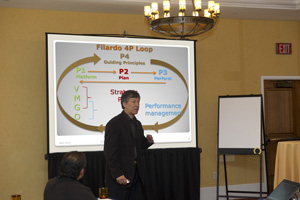
For leaders striving to spark peak performance, Filardo suggested the “Filardo 4P Loop,” a continuous loop of platform (vision, mission, and goals), plan, and perform, anchored by an organization’s guiding principles. The leader’s role in this transformation is a challenging one, he said.
Filardo’s working definition of leadership: “A leader is one or more people who select, equip, train, and influence followers who have diverse gifts, abilities, and skills, and focuses the followers to the organization’s mission and objectives, causing the followers to willingly and enthusiastically expend spiritual, emotional, and physical energy in a concerted, coordinated effort to achieve the organization’s mission and objectives. The leader achieves this influence by humbly conveying a prophetic vision of the future in clear terms that resonate with the followers’ beliefs and values in such a way that the followers can understand and interpret the future into present-time action steps.”
Leaders must craft a vision of future performance that describes the future, said Filardo. This vision spells out where you are headed or where you want to end up. It also should define how the organization would like to be regarded by those it serves.
“It focuses on the distant future, looking ahead about five to 10 years or longer,” Filardo said. “It is short and concise. And it must be inspiring.”
This future-focused approach should include strategies that will produce the necessary changes to achieve the leader’s vision. Management will support this through activities such as budgeting and planning. Meanwhile, managers will set targets for improving quality or delivery performance, spelling out specific steps (and required resources) to accomplish those plans.
Effective Awareness and Engagement
There are several reasons people don’t follow through on their plans. They may treat the plan as an event or program rather than a process. Or the entire enterprise could suffer from poor communication and lack of leadership. Leaders can build momentum for needed change through an awareness campaign, Filardo said. First, gather the team and publicly support the vision and mission of the organization and the methodology chosen to achieve them. Next, build understanding by working with team members to convey the mission and vision in a way that each team member understands.
Additional steps in building momentum include:
- Creating alignment or understanding of where people are going;
- Executing the plan by using agreed-upon standards and tools (six sigma, etc.);
- Using standard performance metrics to prevent the organization from reverting to old ways;
- Innovating or continuously improving by adding new elements such as new steps to reduce cycle times or costs.
Make excellence a habit to encourage individuals and teams in new behaviors. Consistently use project management skills, build a “metrics culture, and lead,” Filardo said.
“People are encouraged to change when the answer to the question, ‘What’s in it for me?’ improves their well-being,” he said. “When people in the organization speak about what is in it for them, they have a better understanding about why quality or other improvements are necessary – they are beginning to buy in.”
People buy into well-defined guiding principles, Filardo said. For example, the organization can emphasize integrity, teamwork, quality, accountability, leadership, customer service, and stewardship (striving to make the best use of resources within the organization’s control and supporting others in doing the same, recognizing that the organization is a caretaker of these resources).
“Culture is ever-changing as a result of people movement, product changes, and market dynamics,” he said. “It’s more than declaring, ‘We have a great culture.’” Fostering cultural change is a critical element of an organization’s ability to create and sustain enterprise-wide performance gains, he said.